A special edition. A useful place to start.
The shortcut is not a better adjective. It is finding the experience your first draft left out. Here is a practical way to use AI before, during, and after the writing.
Start with evidence
Everyone has the job description. You have your experience.
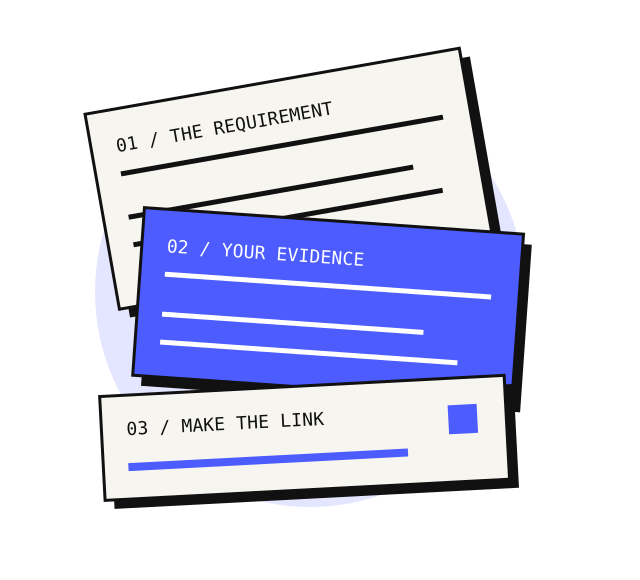
“Tailor my résumé to this job” starts with the documents already on the screen. What if your best example is missing from your résumé? What if the bullet says “assisted” because you never unpacked the work?
The first job for AI is to ask better questions. Drafting comes after you have something worth saying. Harvard’s career guidance similarly treats AI output as material to review and adapt, with accuracy and your own voice at the center. Harvard’s guidance on AI and applications.
Start with a role’s actual tasks. “Analytical” is broad. “Investigate why delivery estimates differ from actual arrivals” gives you a clearer question: when have you compared a prediction with reality, found a pattern, or explained a discrepancy?
Relevant experience does not have to share the job title. It does need a defensible connection. A class project is still a class project. A student event is still a student event. Specificity makes those experiences useful without disguising them as paid employment.
Interview your experience
Build a small evidence bank.
Pick one moment: a project that stalled, a disagreement you worked through, a confusing dataset, an event you organized, or a mistake you corrected. Write rough notes before worrying about style.
- Context: Who was involved, and what needed to happen?
- Ownership: What was specifically your responsibility?
- Judgment: What did you choose, and why?
- Result: What happened that you can actually support?
- Limit: What did this example not demonstrate?
Try this prompt: “Help me examine a real experience for [requirement]. Ask one question at a time. Separate my actions from the team’s. Ask what evidence supports the result. Keep unknown details blank. Summarize the facts for my approval before suggesting application wording.”
Remove private identifiers, confidential employer material, and other people’s personal information before using an AI service. You can describe a task without uploading the underlying client file.
If you cannot recall a result, say so. The next question might be whether the work was adopted, reviewed, presented, corrected, or completed. If none can be established, keep the claim limited to the action you know you took.
One example, three uses
Same facts. Different jobs.
Here is a sample experience: a student noticed that teammates interpreted missing survey responses differently. The student documented a common rule, checked a subset of records, and explained the choice in the final presentation. No measured improvement was recorded.
RÉSUMÉ
“Documented a shared rule for missing survey responses, checked a sample of records, and explained the method in our team’s final presentation.”
This is a factual starting point. Emphasize the part relevant to the job without inventing scale, tools, or impact.
COVER LETTER
“Your research-assistant role calls for careful data documentation. In a course project, I noticed inconsistent treatment of missing survey responses and documented a shared approach for our team. That experience made me more deliberate about explaining data decisions so others can follow them.”
A cover letter should make a case, not narrate every résumé bullet. Choose one or two requirements, show evidence, and explain a specific reason the organization’s work interests you. Check any company detail on its own website before using it.
For the interview, hold onto the same facts but prepare to explain the reasoning. Why that rule? Who agreed to it? What would you improve? A polished paragraph is not preparation for those follow-ups.
Make the Link
STAR-L gives the answer an ending.
STAR organizes a behavioral answer around Situation, Task, Action, and Result. The National Careers Service explains the familiar framework. We add L for Link: connect the experience to something this job requires. National Careers Service’s STAR explanation.
- Situation: Our project group handled missing survey responses differently.
- Task: I was responsible for preparing our analysis notes.
- Action: I documented a common rule, checked a sample, and explained it to the group.
- Result: We used the documented approach in our final presentation. We did not measure an improvement in accuracy.
- Link: That experience is relevant to this role’s need for clear, traceable research records.
The Link should be a sentence you can justify, not a claim that one project proves you can do the whole job. Use our STAR-L builder to produce speaking notes, then practice without reading a script.
Not every interview question needs STAR-L. For “Why this role?”, connect a specific responsibility to your interests and evidence. For “Tell me about yourself,” give a short thread through your relevant experience. Save the full story structure for questions asking what you did in a particular situation.
Practice the difficult part
Ask AI to challenge the story.
Practice prompt: “Act as an interviewer for [role]. Ask one behavioral question. After my answer, ask a follow-up about my personal contribution, a trade-off, or evidence for the result. Identify any unsupported claim. Give feedback on clarity and relevance, not on making me sound impressive.”
Use a simple self-check after each attempt: did you answer the question, name your action, explain an outcome accurately, and make a relevant Link? If the answer is missing a piece, go back to the facts before polishing the phrasing.
Three questions worth rehearsing.
- “Tell me about a mistake.” Choose an actual error, explain your response, and identify what you changed afterward. Avoid turning a supposed weakness into praise.
- “Describe a disagreement.” Explain the difference in judgment and how you handled it. Your colleague does not need to become the villain.
- “What did you contribute?” Separate the group’s outcome from your individual work. This matters especially for coursework and team projects.
Try a shorter version and a fuller version of the same answer. The aim is flexibility in a conversation, not a memorized speech with one permitted route through it.
Before you hit send
Read it as someone who will ask follow-ups.
- Check the facts. Every date, tool, number, title, and result should be something you can explain.
- Check the fit. Can the reader see how your example relates to the role without decoding a list of keywords?
- Check the language. Replace any sentence you would never say aloud. Keep technical terms when they are accurate and useful.
- Check the instructions. Follow the employer’s requested format and any stated rules about AI assistance or assessments.
- Check the document. Open the exported file. Look for broken spacing, wrong company names, and comments left in the draft.
For industry roles, follow the posting’s request for a résumé; academic applications may ask for a CV with different detail. Do not compress or expand a document simply because a generic template says to.
Save your final application beside the posting and evidence notes. If an interview arrives later, you should be able to reconstruct exactly what you claimed.
Start with the free evidence planner. For a deeper walkthrough, use our cover-letter guide. Your goal is an application you can defend, not an application that merely sounds finished.
Your status may be TBD. Your information shouldn’t be.
Status: TBD · Published and sources checked September 24, 2026. This special edition is a practical starting point, not a promise of eligibility or outcomes. Immigration decisions require current guidance from your school’s international office or qualified counsel. Sample answers illustrate the method; use your own experience.